# The Autonomous Work Horizon Is Doubling Every Five Months
By Laith Al-Saadoon · Published 2026-03-05 · Updated 2026-09-11
Canonical: https://laithalsaadoon.com/notes/autonomous-work-horizon
Topics: Autonomy, Benchmarks, METR
A March 2026 analysis of METR task horizons: a 4.8-month doubling trend, its reliability limits, and why human task duration is not agent runtime.
This analysis was run in **March 2026**. A fit to eight frontier model observations suggested a 4.8-month doubling time for METR's 50% task-completion horizon. That horizon describes how long the tasks take human experts, not how long an agent runs unattended. The original chart is a dated exploration of that trend, not a live capability dashboard.
The task-completion threshold matters: 50% success is useful for tracking capability, but is not a reliability target for unattended production work.
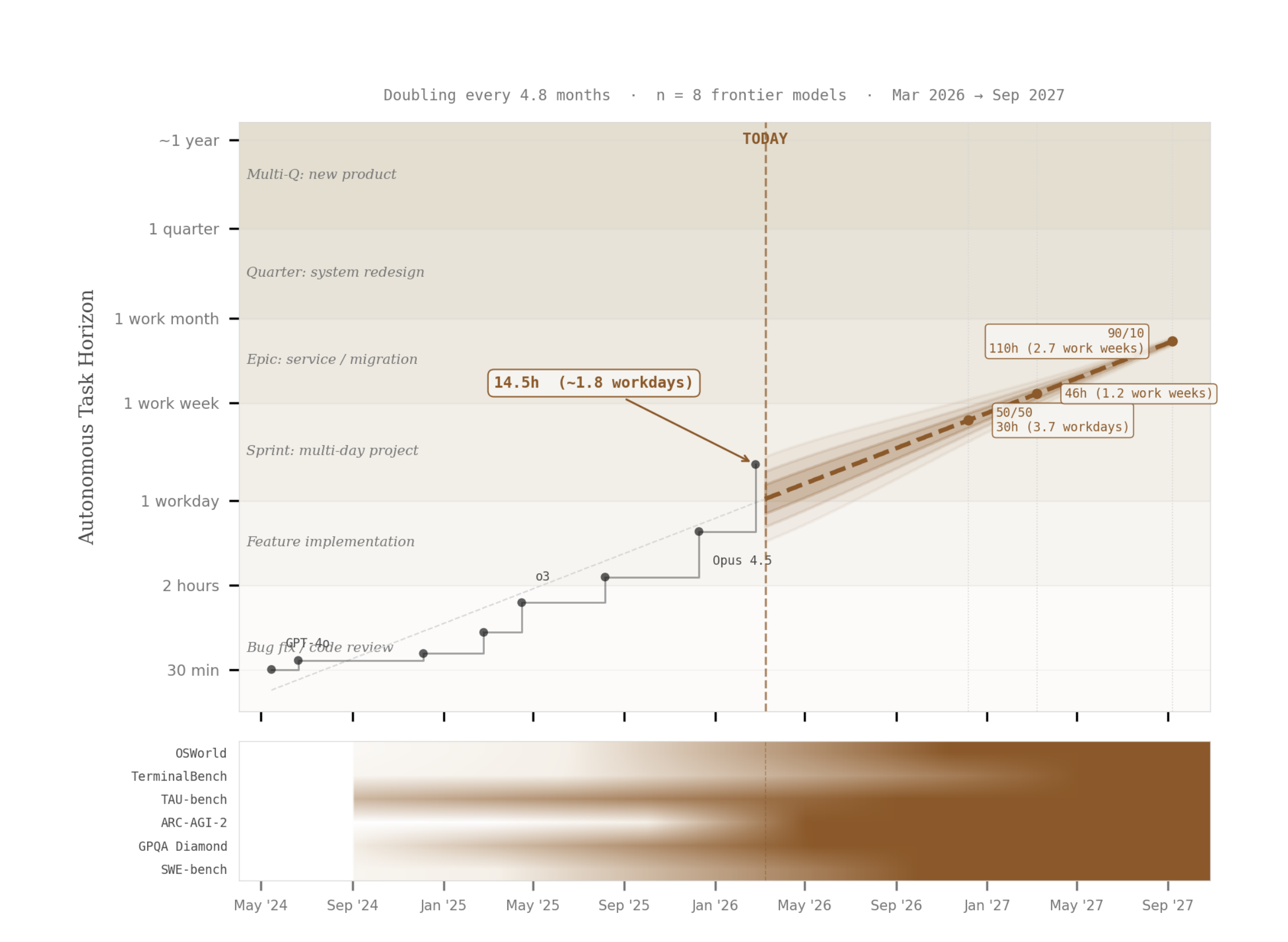
Fig. 1. METR autonomous time horizon mapped to work-function zones, with conviction-calibrated projection bands (50/50 at nine months, 90/10 at eighteen). Bottom strip: six benchmarks lighting up as they approach saturation. n=8 frontier models, three labs, September 2024–March 2026. Original March 2026 visualization, retained unchanged. The bands show subjective conviction, not statistical prediction intervals; horizon values refer to human task duration.
## What the March 2026 analysis measured
The dataset covers seven benchmarks, one hundred and twenty data points, three model families, and eighteen months of system card releases. For this March 2026 analysis, I collected performance scores from every frontier model since September 2024 (Anthropic's Claude 3.5 Sonnet through Opus 4.6, OpenAI's GPT-4o through GPT-5.3 Codex, Google's Gemini 1.5 Pro through 3.1 Pro) and fit regression lines forward with calibrated conviction bands.[1](https://laithalsaadoon.com/notes/autonomous-work-horizon#ref-1)
The picture that emerged has two distinct layers. The first is familiar, since discrete-task benchmarks are saturating. SWE-bench Verified climbed from 33% to 81% in eighteen months. GPQA Diamond went from 51% to 94%. ARC-AGI-2, the steepest trajectory in the dataset, rose from 0% to 85% in twelve months.[2](https://laithalsaadoon.com/notes/autonomous-work-horizon#ref-2) OSWorld crossed the human baseline of 72.4%.[3](https://laithalsaadoon.com/notes/autonomous-work-horizon#ref-3) These scores show progress on the measured tasks. They do not establish that coding, reasoning, or computer use is solved outside those benchmarks.
In this March 2026 sample, the 50% task-completion horizon doubled roughly every five months. **Capability growth is not the same as dependable delegation.**
## Human task duration is not agent runtime
The second layer is the one that matters for workforce planning. METR's task-completion horizon is the human-expert duration of tasks a model is predicted to complete at a specified success rate. It does not measure an agent's uninterrupted wall-clock runtime.[4](https://laithalsaadoon.com/notes/autonomous-work-horizon#ref-4)
In May 2024, GPT-4o managed thirty minutes, about the length of a bug fix. By February 2026, Opus 4.6 reached 14.5 hours, a human-task-duration estimate at 50% success, not two reliable workdays of autonomous execution.[5](https://laithalsaadoon.com/notes/autonomous-work-horizon#ref-5) A log-linear regression through eight frontier data points yields a doubling time of 4.8 months, consistent with METR's own measured range of four to seven months.
The chart reads in two layers. The main panel maps METR's exponential against work-function zones: bug fixes at the bottom, sprint-level project work in the middle, quarterly system redesigns near the top. The historical frontier occupies the left edge, a staircase of discrete leaps as each new model set a record. The right side belongs to the projection, where conviction-calibrated bands narrow from wide uncertainty at nine months to a tight line at eighteen.
The bottom strip compresses six benchmark trajectories into a heatmap. Each row tracks a benchmark's regression-predicted score over time, from blank to warm brown at saturation. The fitted scores approach the benchmarks’ ceilings. Those projections are not evidence that the underlying work is solved. METR adds a complementary measure of task length at a specified success rate.
• • •
Stanford's 2025 AI Index strengthens the case in a way the raw benchmarks cannot. AI systems now exceed human baselines on seven of eight tracked performance metrics, a crossing that happened between 2023 and 2025.[6](https://laithalsaadoon.com/notes/autonomous-work-horizon#ref-6) The RE-Bench evaluation provides a sharper lens. At two-hour task durations, AI produces work at four times the quality of human experts.[7](https://laithalsaadoon.com/notes/autonomous-work-horizon#ref-7) That advantage decays toward longer horizons (at thirty-two hours, humans still outperform two-to-one), but for the growing share of knowledge work that falls within the current capability ceiling, the compression is already happening.
These evaluations do not support a direct conversion from METR hours to human-equivalent workdays. Runtime, task mix, retries, review effort, and reliability all affect delivered output. That conversion needs measurements from a real workflow, not a multiplier applied to a benchmark horizon.
Benchmark scores describe performance on a test. **Deployment requires evidence about reliability, supervision, and useful output.**
**What did I miss?** If you have data that complicates the trajectory or benchmarks I should be tracking, reach out on [LinkedIn](https://www.linkedin.com/in/laithalsaadoon/).
• • •
A word on the original March 2026 conviction bands. The bands in the chart contract as they move forward in time. At nine months, I model fifty-fifty uncertainty, because I do not know which model ships when, or what its capability profile looks like. At eighteen months, I model ninety-ten conviction, because the aggregate trajectory of seven benchmarks across three labs converges with high confidence, even though individual releases remain unpredictable.[8](https://laithalsaadoon.com/notes/autonomous-work-horizon#ref-8)
Those narrowing bands express my subjective conviction in March 2026. They are not statistical confidence or prediction intervals, and do not establish that forecast uncertainty decreases with time. The image is retained as the original analysis; its visual precision should not be mistaken for a calibrated probability of future capability.
## Reliability and limits
The caveats come from METR themselves.[9](https://laithalsaadoon.com/notes/autonomous-work-horizon#ref-9) The fifty-percent time horizon means the agent succeeds half the time on tasks of that length. The eighty-percent threshold is far lower, and even that may be insufficient for high-consequence work. Opus 4.6 is 14.5 hours at fifty percent but roughly one hour at eighty percent. The tasks are primarily software engineering, machine learning, and cybersecurity; other knowledge work domains are unmeasured. And the confidence intervals on individual models are wide: Opus 4.6's ninety-five percent band spans 6 to 98 hours.
The historical direction was clear in this sample; the extrapolation remains uncertain. METR reported a longer-run exponential trend; my eight-point fit across three labs is a much smaller sample. Whether the eighteen-month projection lands at sixty hours or one hundred and fifty, neither number on its own demonstrates reliable ownership of a workstream.
## References
Data collection methodology: five parallel research agents querying system cards from Anthropic, OpenAI, and Google/DeepMind, plus independent leaderboard data from swebench.com, arcprize.org, taubench.com, tbench.ai, and METR evaluations from metr.org. 120+ data points archived.
ARC Prize Foundation, "ARC-AGI-2 Leaderboard." [https://arcprize.org/leaderboard](https://arcprize.org/leaderboard)
Tianbao Xie et al., "OSWorld: Benchmarking Multimodal Agents for Open-Ended Tasks in Real Computer Environments." [https://arxiv.org/abs/2404.07972](https://arxiv.org/abs/2404.07972)
Thomas Kwa, Ben West, Joel Becker et al., "Measuring AI Ability to Complete Long Tasks," METR, March 2025. [https://metr.org/blog/2025-03-19-measuring-ai-ability-to-complete-long-tasks/](https://metr.org/blog/2025-03-19-measuring-ai-ability-to-complete-long-tasks/)
Anthropic, "Claude Opus 4.6 System Card," February 2026. METR 50% time horizon 14.5 hours, 95% CI 6–98 hours. [https://www.anthropic.com/claude-opus-4-6-system-card](https://www.anthropic.com/claude-opus-4-6-system-card)
Stanford Institute for Human-Centered AI, "AI Index Report 2025," Chapter 2: Technical Performance. [https://hai.stanford.edu/ai-index/2025-ai-index-report/technical-performance](https://hai.stanford.edu/ai-index/2025-ai-index-report/technical-performance)
METR, "RE-Bench: Evaluating Frontier AI R&D Capabilities of Language Model Agents Against Human Experts." [https://arxiv.org/abs/2411.15114](https://arxiv.org/abs/2411.15114)
Conviction bands use Weibull-style decay: decay=exp(-(t/11.08)1.732), analytically calibrated to 50% uncertainty at 9 months and 10% at 18 months.
METR, "Measuring AI Ability to Complete Long Tasks," Section 5: Caveats and Limitations. [https://metr.org/blog/2025-03-19-measuring-ai-ability-to-complete-long-tasks/](https://metr.org/blog/2025-03-19-measuring-ai-ability-to-complete-long-tasks/)
Kiran Tomlinson et al., "Working with AI: Measuring the Applicability of Generative AI to Occupations," Microsoft Research, July 2025. [https://arxiv.org/abs/2507.07935](https://arxiv.org/abs/2507.07935)
OpenAI, "GPT-5 System Card," August 2025. [https://cdn.openai.com/gpt-5-system-card.pdf](https://cdn.openai.com/gpt-5-system-card.pdf)
METR, "Time Horizon 1.1," January 2026. Updated task suite (170 → 228 tasks). [https://metr.org/blog/2026-1-29-time-horizon-1-1/](https://metr.org/blog/2026-1-29-time-horizon-1-1/)
METR, "How Does Time Horizon Vary Across Domains?" July 2025. [https://metr.org/blog/2025-07-14-how-does-time-horizon-vary-across-domains/](https://metr.org/blog/2025-07-14-how-does-time-horizon-vary-across-domains/)
Epoch AI, Capabilities Index, compute trends, and AI datacenter power tracking. [https://epoch.ai/data](https://epoch.ai/data)
METR, "Research Update: Algorithmic vs. Holistic Evaluation," August 2025. [https://metr.org/blog/2025-08-12-research-update-towards-reconciling-slowdown-with-time-horizons/](https://metr.org/blog/2025-08-12-research-update-towards-reconciling-slowdown-with-time-horizons/)
SWE-bench leaderboards [https://www.swebench.com/](https://www.swebench.com/) | TAU-bench [https://taubench.com/](https://taubench.com/) | Terminal-Bench 2.0 leaderboard [https://www.tbench.ai/leaderboard/terminal-bench/2.0](https://www.tbench.ai/leaderboard/terminal-bench/2.0)
A benchmark trend cannot tell you whether your own agent is improving. For that, start with [evals tied to the work you actually ask it to do](https://laithalsaadoon.com/notes/agent-evals).
## Related reading
- https://laithalsaadoon.com/notes/agent-evals
- https://laithalsaadoon.com/notes/agent-needs-computer